Every company starts as one idea.

Then it grows.

Engineering. Sales. Finance. Design. People.

Brilliant people, in different rooms.

Divided.

Then one person says hello.

Ideas that move, connect, build.

Engineering meets Sales. Design meets Finance.

The best of every team, in one room.

And something new is made.

Together

One team. That’s how companies win.

The strongest companies aren’t the biggest. They’re the most connected.

  • One team
  • Openness
  • Simplicity
  • Curiosity
  • Ownership
  • Belonging

How connected companies work

Culture is how we work together.

A plan says where a company is going. Its people, working as one, are how it gets there. Five habits make a company connected: each one completes the ring.

Five habits, one ring

  1. One team

    We win together, and learn together.

    Nobody wins alone. A company is one team when its people know each other across the lines on the chart, and help each other be their best.

    In the app

    Every function in the company, in its colour, filled where you know someone.

  2. Open by default

    Trust starts with knowing who’s who.

    When everyone can see how the company fits together, it’s easier to rely on each other, to listen and to ask. Every view in the room counts.

    In the app

    Everyone who signs in gets the same chart. Every suggestion lists checkable facts.

  3. Simple, on purpose

    Small enough to do, so we do it.

    Big programmes stall. One conversation a week doesn’t: simple enough to keep doing, and clear about why it matters.

    In the app

    One person to meet, with the reasons, the warm path to them.

  4. Bring the outside in

    The answer is often in the next room.

    Fresh ideas live in other teams, at other sites and with the people who joined last week. Curious companies go and find them.

    In the app

    Where you know nobody yet, across functions, leaders and sites. Facts from your records and your organisation's chart.

  5. Owners, not passengers

    We do what we said we’d do.

    Anyone can reach anyone, and each of us owns the follow-through: the coffee booked, the catch-up kept, with respect for each other’s time.

    In the app

    Log a conversation in a few clicks. It suggests when to catch up again: in a fortnight after one that went well, a month after one that was fine, six weeks after one that wasn't.

The product

Small steps, every week.

The app’s own pages, on the demo’s fictional organisation.

Demo data: fictional people

For Alex Carter · 1 of 3

Carlos Romero

Director of Digital Products · Digital

  • You know them a little: deepen it
  • Digital, like you
  • 2 direct reports

First step: Ask how they got into their role and what it needs: 20 minutes over coffee or a call.

Who to meet next

Every suggestion lists checkable facts, and a proportionate first step.
Kofi Mensah

Head of Application Engineering · Digital

Press a key: they move to a ring.

Nothing you press here is kept.

Quick rate

One key or tap per person: about three minutes for 40 people.

  1. YouDevOps Lead
  2. 1John Bradleyyou know them · 3/5
  3. 2Ruth OkaforJohn's manager

The way to someone

Click anyone on the map for the way to them: the route from you, through the people in between, in bold and numbered.

  1. Weeks 1–2, your team
  2. Weeks 3–6, your part of the business
  3. Weeks 7–12, across the business

Your first 90 days

Make my plan lists the 10–15 people to meet first, in three steps, from organisation facts only.

  • Zara AhmedNew manager · Transformation Programme Manager
  • Charlotte EvansJoined · Strategy Director

What changed

Who joined, who left, and who has a new manager or title, between your organisation imports. Plan it plans a welcome or congratulations.

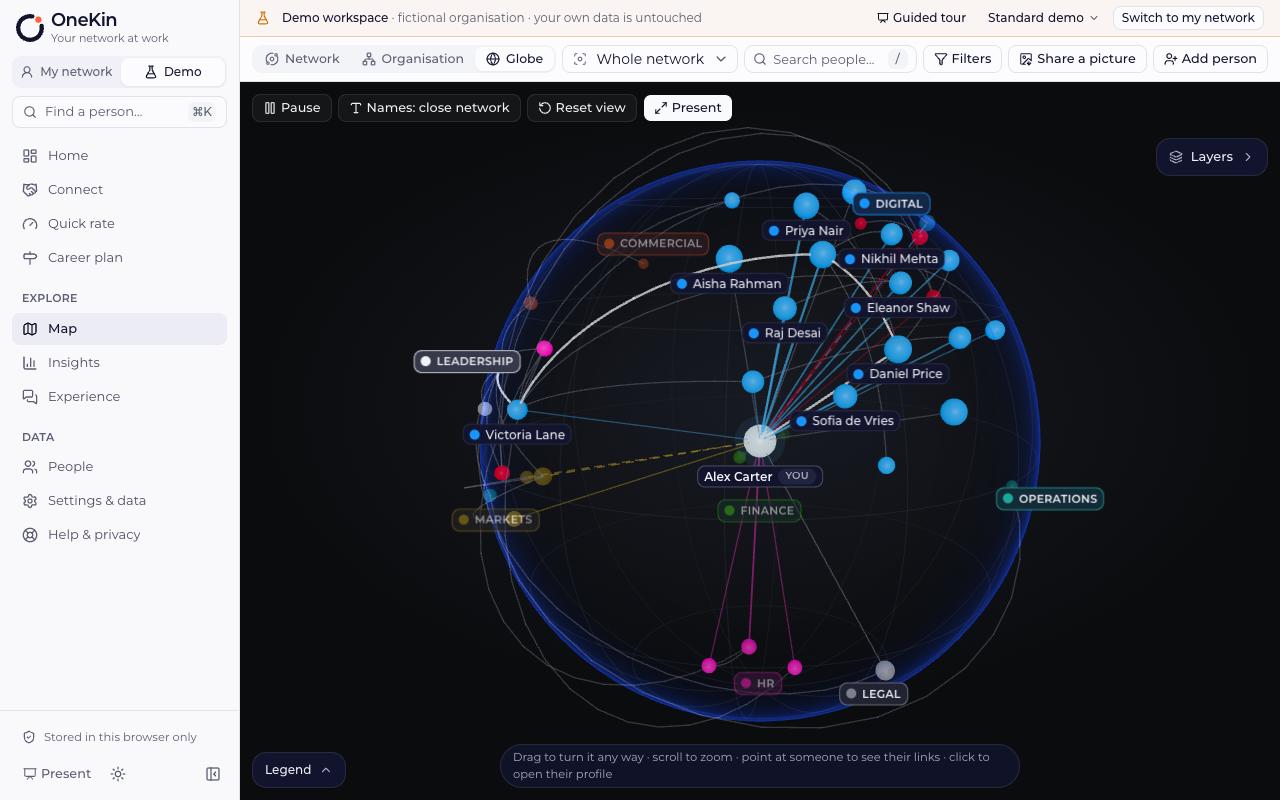
The whole organisation, in your hands.

You’re at its centre, and everyone else is spread over its surface. Each function (and Leadership) has its own region, sized by its people.

Demo data: fictional people

Swipe sideways to turn it. Tap anyone for the way to them.

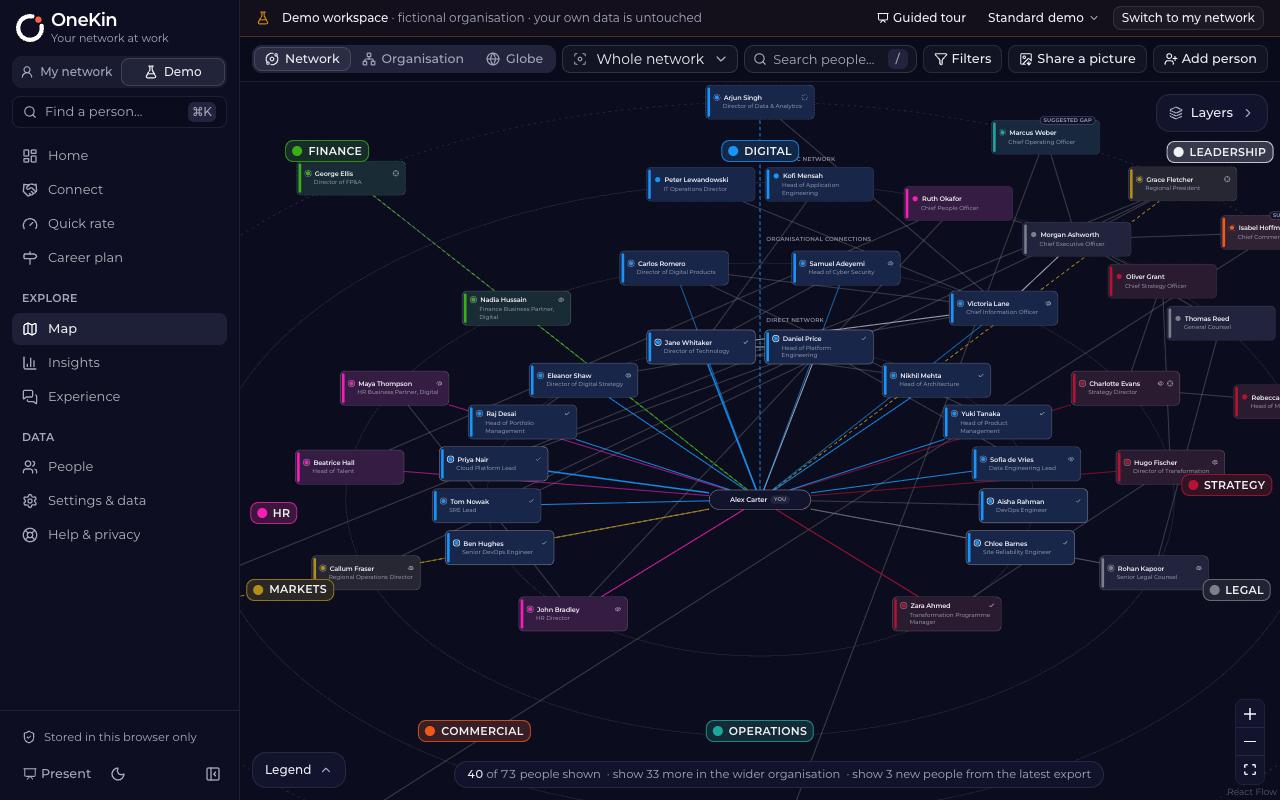
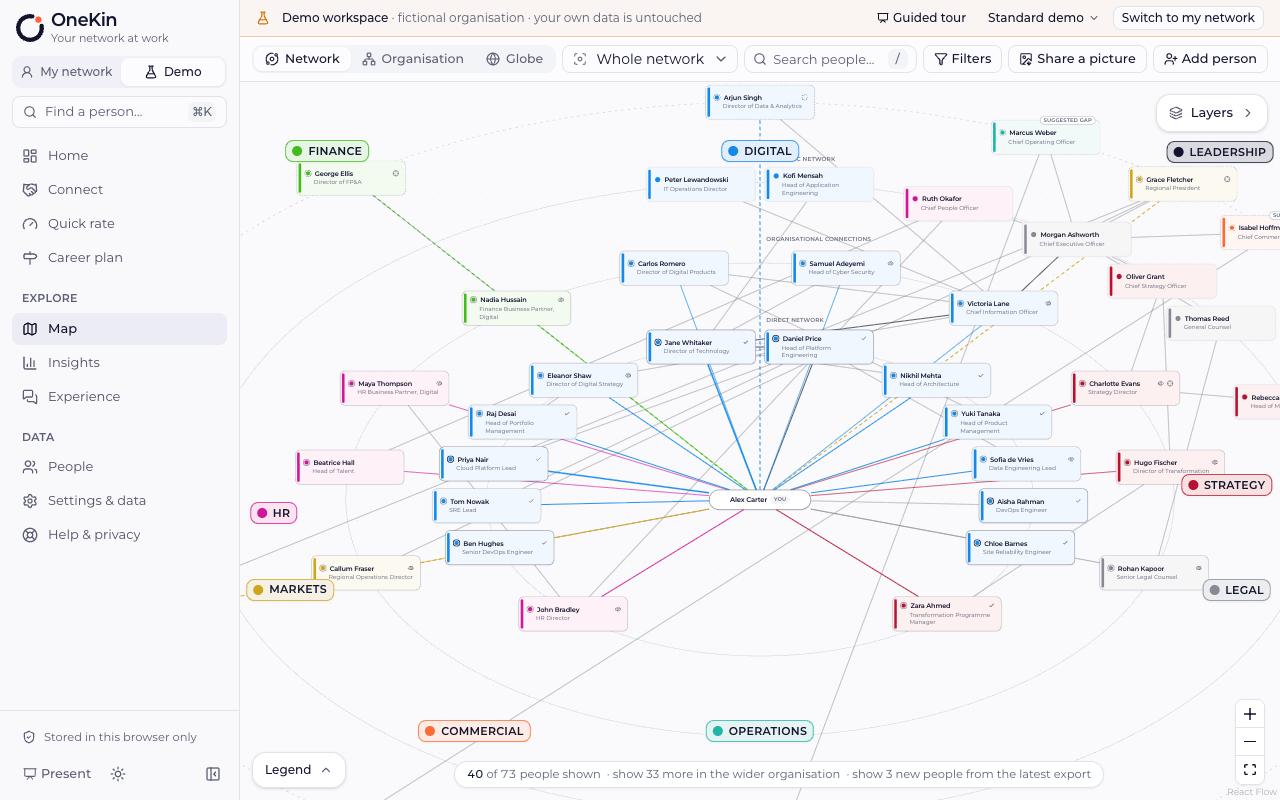
OneKin’s Network map on the demo organisation: the rings round Alex Carter, everyone in their function’s colour, the lines to the people Alex knows.
Network map
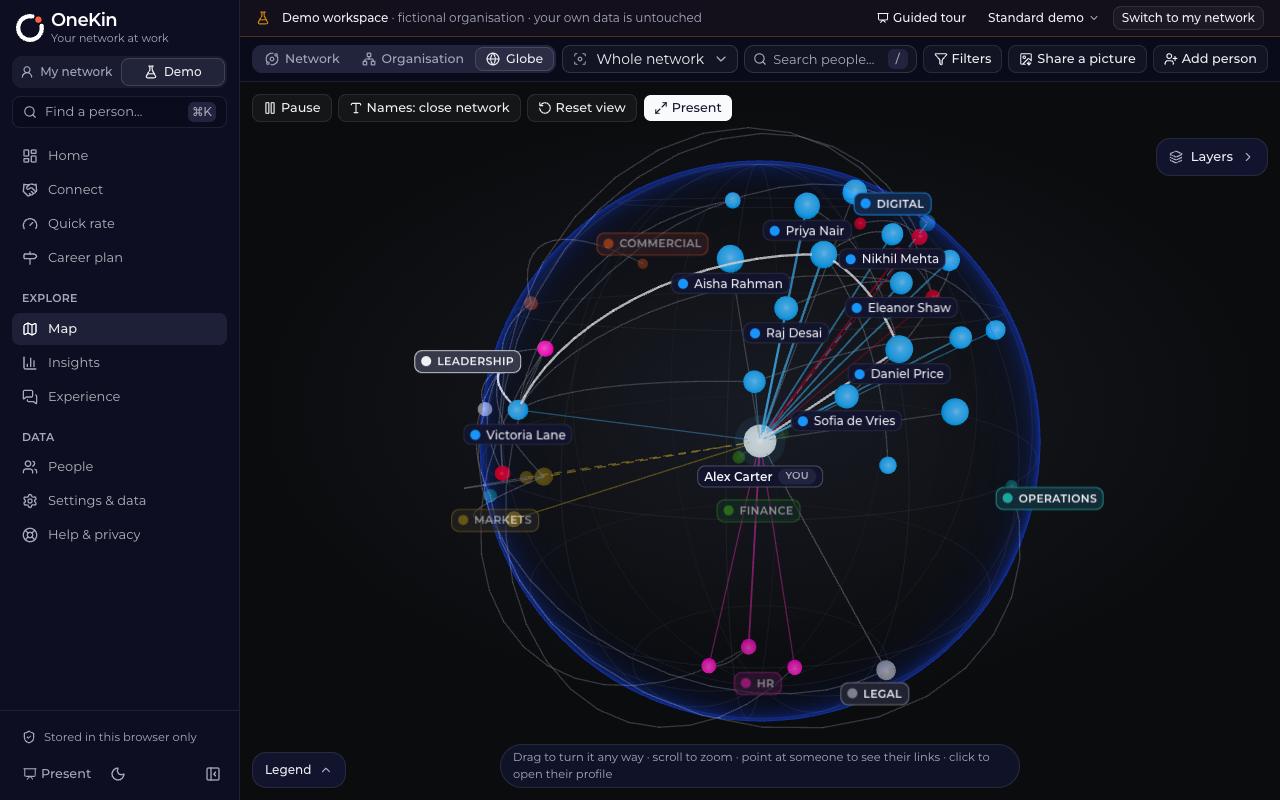
OneKin’s Globe on the demo organisation: Alex Carter at its centre, everyone on its surface by function, the people Alex knows named.
Globe
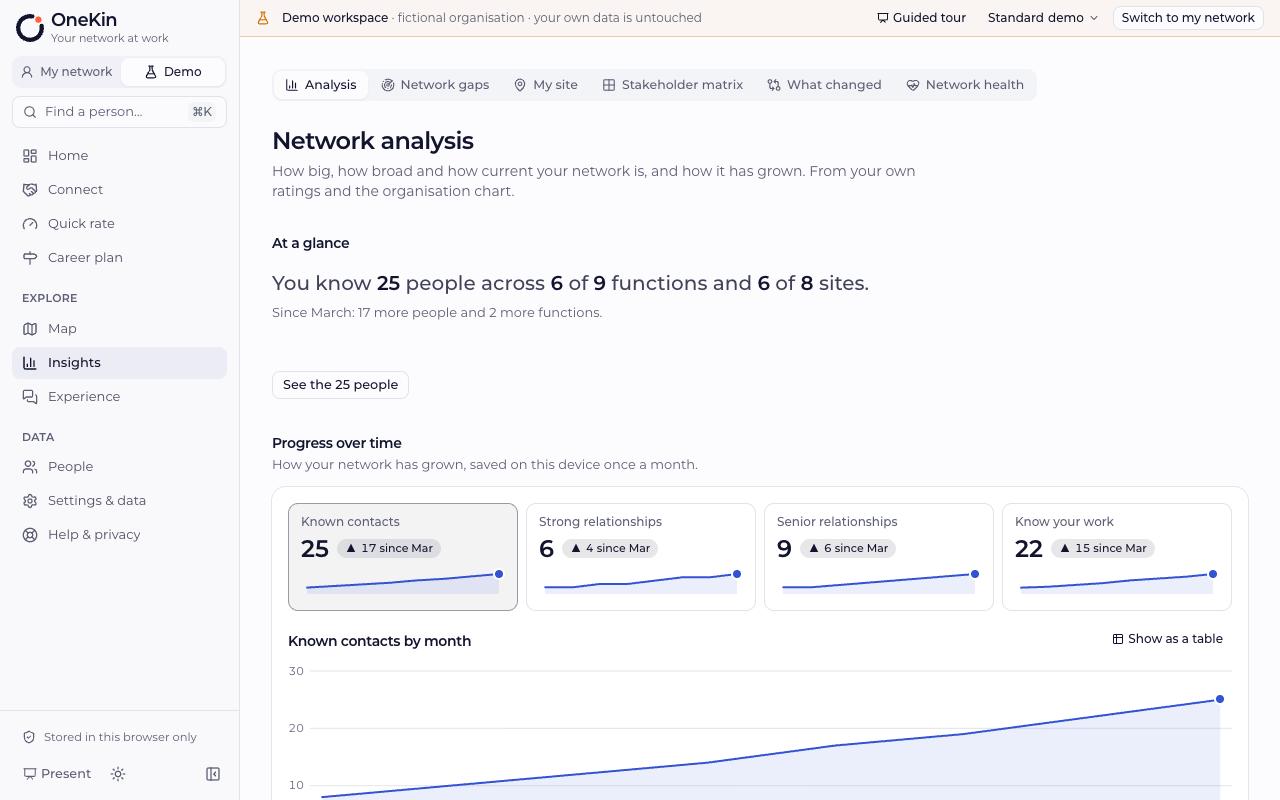
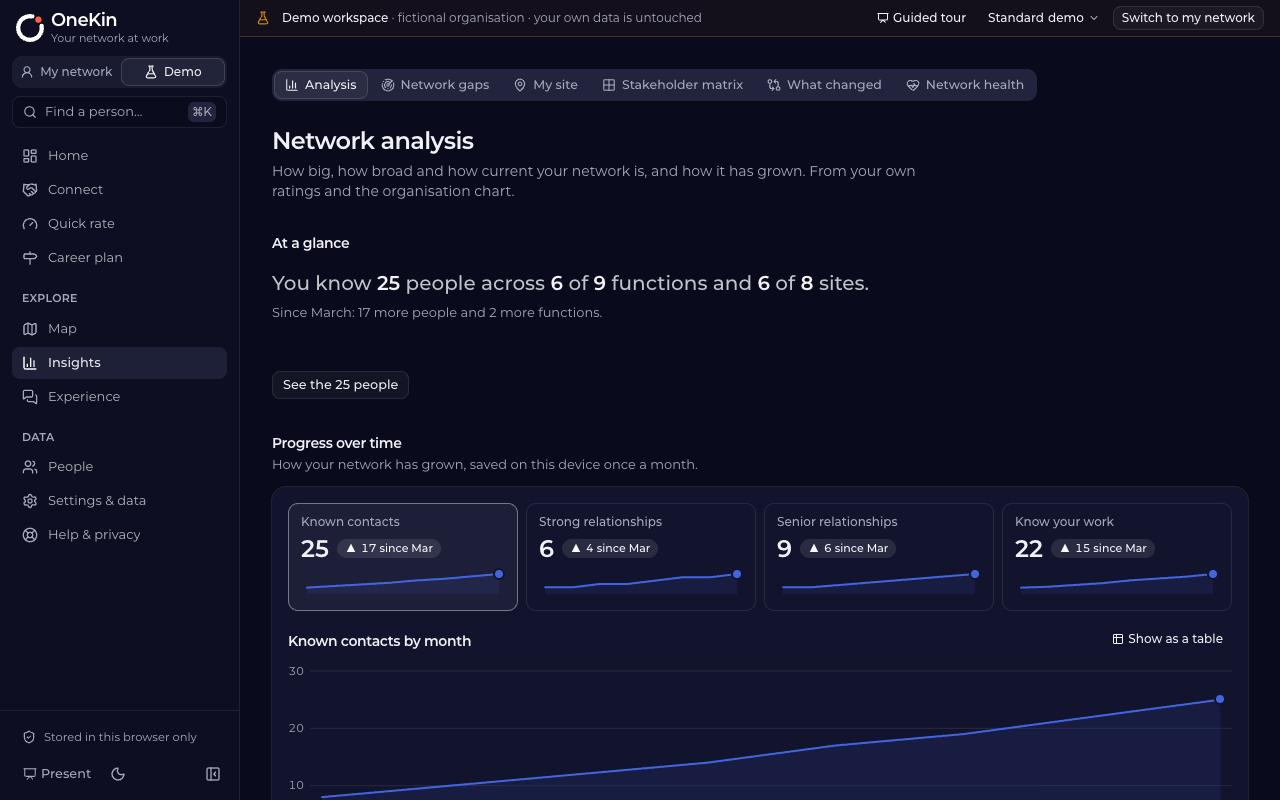
OneKin’s Analysis on the demo organisation: how many people Alex Carter knows across how many functions and sites, and how it has grown.
Analysis
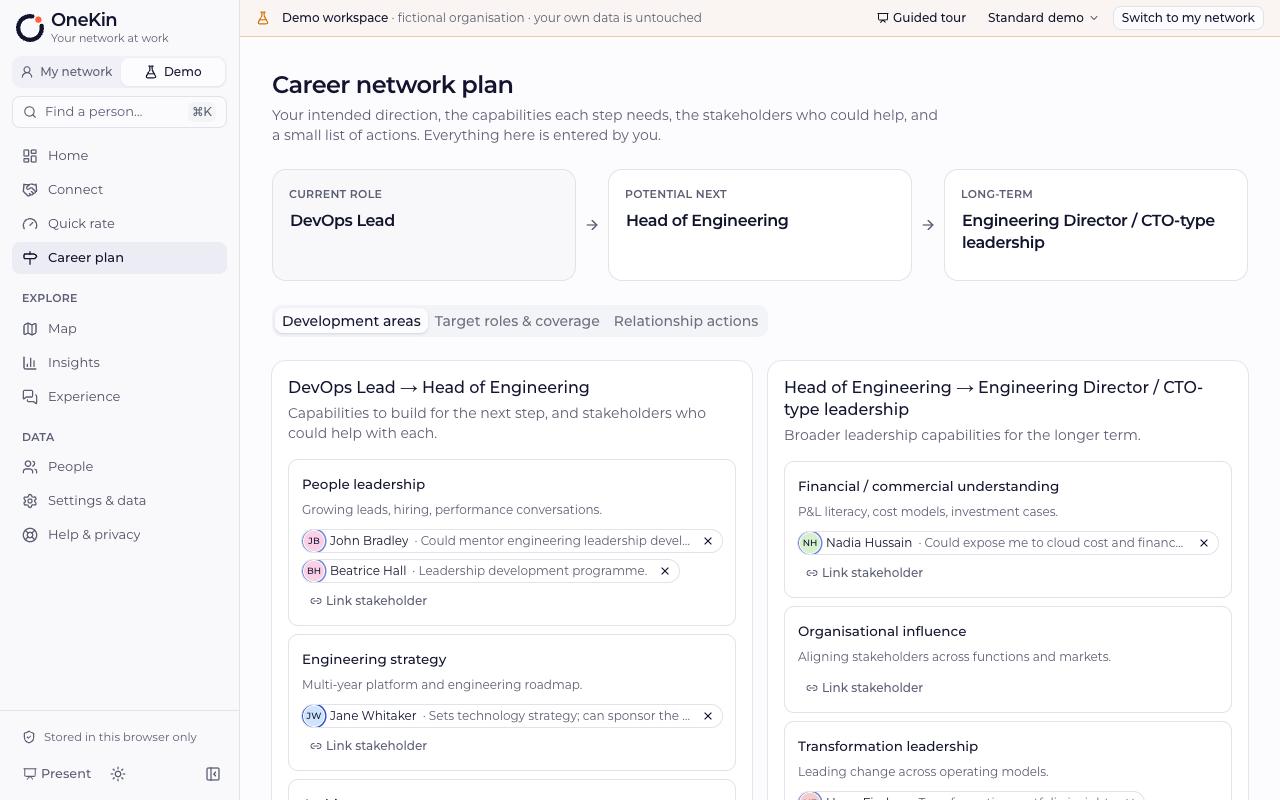
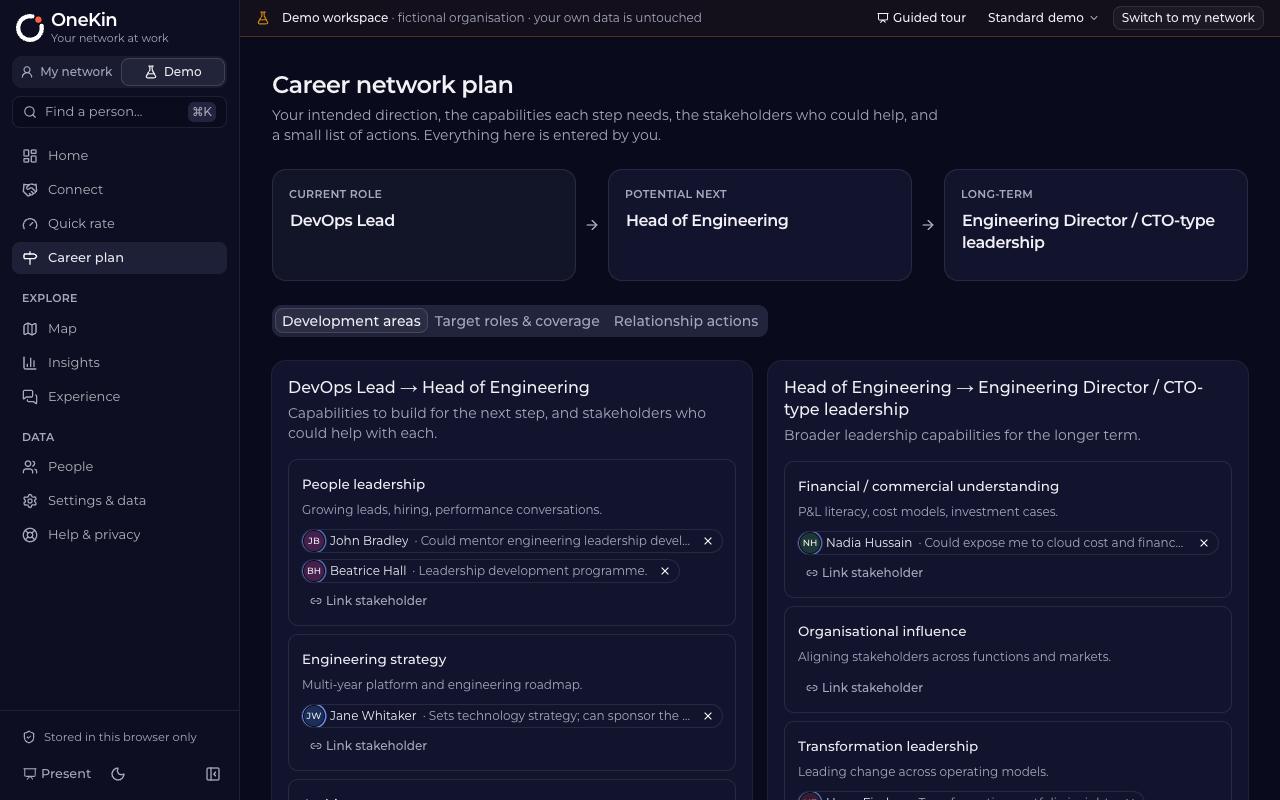
OneKin’s Career plan on the demo organisation: Alex Carter’s current, next and long-term roles, and the stakeholders who could help.
Career plan
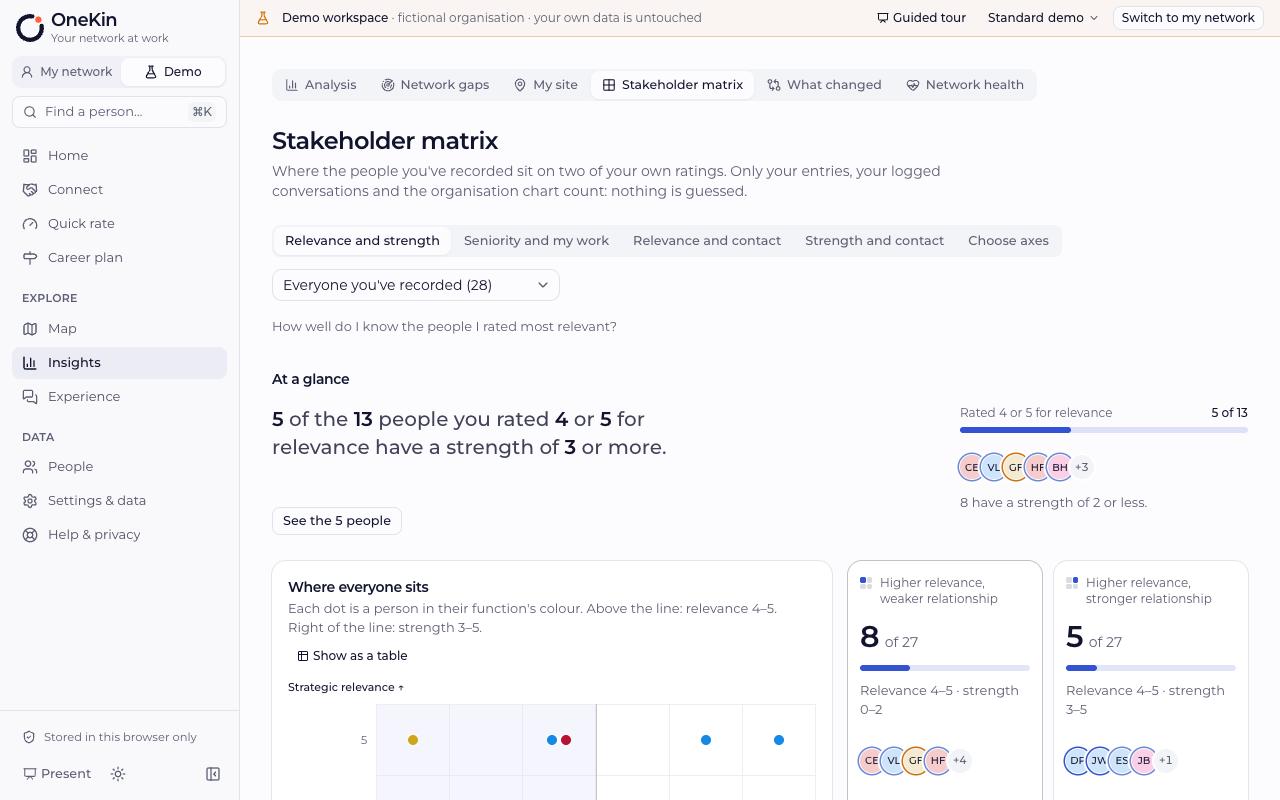
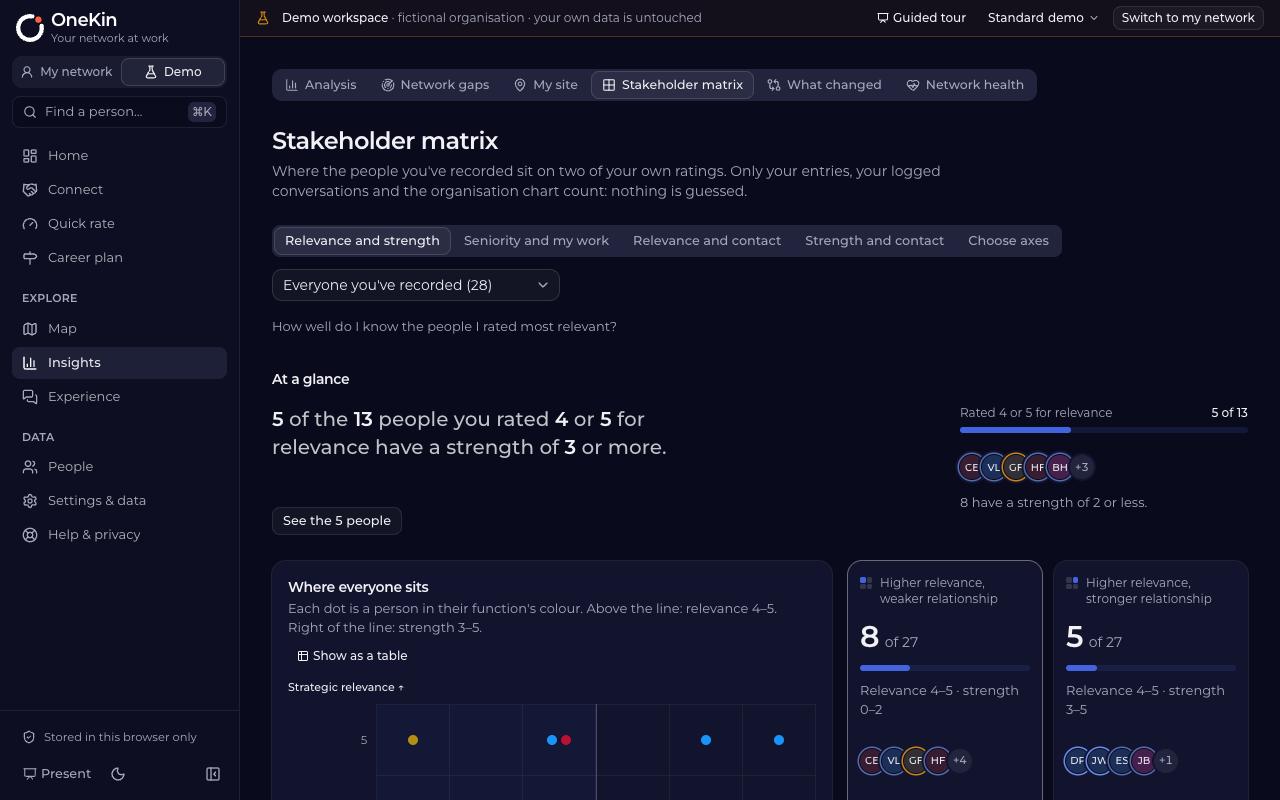
OneKin’s Stakeholder matrix on the demo organisation: the people Alex Carter rated, placed on two of their own ratings.
Stakeholder matrix

Private by design

Stored only in this browser

Yours alone.

Your ratings, notes and plans stay in your browser, or are encrypted on your device before they’re saved to an account. Nobody else can read them: not your company, and not OneKin.

Your records, in your browserWhat you record never leaves your browser, or, if you turn on your records on every device, leaves it only encrypted with a key that only you hold.
Encrypted on your deviceRatings, notes and plans stay on your device, or are encrypted on it before they’re saved to an account or your other devices.
Not even your companyYour company provides the organisation chart. It never sees how you rate anyone, who you plan to meet, or what you wrote.

The server never receives them in a form it can read, so no role can read them: not an admin, not HR, not OneKin's staff. The limits, stated plainly

For companies

For everyone at your company, set up once by HR or IT.

Your company provides the organisation chart. It never sees how you rate anyone, who you plan to meet, or what you wrote.

HR loads the chart once

They upload the export, see what it would change, then apply it or discard it. Everyone who signs in gets the same chart.

Everyone signs in with their work email

You're emailed a six-digit code, which lasts 10 minutes and works once. There's no password.

Admins see who has joined, never what anyone records

No permission exists that could read another member's records. Every change of the Admin or HR role is in the company's audit log, which its admins can read.

Priced per employee: talk to us.

Make one team more than a slogan.

Start with the demo: a whole fictional company, ready to explore.